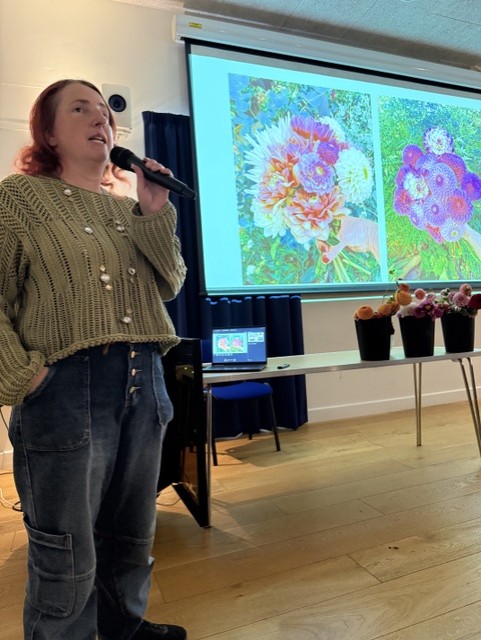
At the October EAGG meeting we all enjoyed Kim’s enthusiastic talk on Dahlias, and she certainly is an expert in the breeding, cultivation and arrangement of this wide-ranging genus of plants. Surprisingly we all mis-pronounce it, which was the first thing we learnt, Darlia being the correct way to say it! She gave us the history of how it was introduced as a food crop, for its tubers – roast, chip or boil – for the edible petals and leaves used for salads. Recently the use of them as a cut flower has become the prevailing fashion, and what a variety we have to choose from.
Good winter storage of tubers is key to successful flowering. When lifting wait for 2-3 frosts so that dormancy kicks in, don’t wash them and leave any earth over the crown to dry out. If hollow stems have water in them, turn them upside down to drain, store in dry compost in a cool dark place, and check periodically for signs of rot or mould. If mould is present dust it over with dry cinnamon. Pot up under cover or indoors, from February to May keeping them at 15 degrees, and feed with fish, blood and bone. When choosing tubers or dividing them it is essential to check that the tuber has all three parts – the bulbous store, the neck and the crown, or they will not flower. They can be propagated from rooted cuttings which is better for flower quality, by removing a shoot from the tuber with a thin sliver of the tuber, alternatively you can rock the shoot very gently until it detaches itself from the main tuber. These can then be rooted in horticultural sand or vermiculite.
Slug control is important, but they are part of the eco system too, so raw wool is good to put around the base of the plants, also try a damp plank of wood soaked with water from the water butt, leave it on the ground and lift in the morning to make your slug collection. Take a torch out at 10pm for a slug watch, apparently they light up, although I have yet to try it!
Stake before you need to and feed your beautiful plants with Tomorite or any liquid seaweed feed, keep deadheading by cutting low to the next branch, the same when cutting blooms.
My notes were numerous and hopefully I wrote everything down correctly. Kim had so much information, and as someone who struggles to achieve any success with Dahlias I am almost tempted to have another go, so good luck everyone.
Erica Legge